Computational Fluid Dynamics (CFD) is a computer-aided method used to simulate fluid flow in both closed and open systems. CFD allows engineers to predict and analyze the behavior of gases and liquids within a virtual model, accelerating the development of new products and making the process more cost-efficient.

A typical CFD simulation process involves creating a virtual model of the system to be analyzed, setting boundary conditions, and conducting the simulation itself. The results, which can be presented as data or visualizations, help understand and assess the flow dynamics.
To perform an accurate and reliable CFD simulation, it’s crucial to understand the physical principles governing fluid flow and to have a solid knowledge of the simulation software being used. However, user-friendly tools are available that can still deliver precise results without requiring deep expertise.
In this article, we will detail the typical steps involved in a CFD simulation and explain the key considerations for each stage.
Geometry Preparation


The initial step in any numerical flow simulation is to create a digital representation of the part to be studied using CAD software. Often, only the spaces filled by gas or liquid—the negative volume of the geometry—are relevant for the simulation. For thermal studies, the walls and surrounding components must also be included as solid volumes. The engineer decides the level of detail necessary, focusing on elements that affect flow. For example, in an engine compartment, the air navigates past numerous hoses, cables, and other components, all of which must be included for accurate pressure loss calculation and appropriate fan selection.
Discretization

Fluid flow is computed at discrete points within the simulation domain. A 3D grid is created, dividing the domain into cells or control volumes (CV). Each CV has a node where variables like velocity, temperature, and concentration are calculated. The quality of this grid significantly impacts the accuracy of the solution. Creating high-quality grids is time-consuming and requires substantial expertise. Our innovative grid generation technique at Kojouharov & Ceglarski adjusts the grid resolution to the flow conditions and geometry, ensuring adequate resolution of critical near-wall regions for heat exchange.
Model Preparation (Pre-Processing)

Before solving for the desired variables, the complexity of the flow model is defined. Depending on the physical scenario, the decision is made for transient or steady-state analysis. Liquids are generally considered incompressible, whereas gases might need to account for compressibility effects at high Mach numbers. Turbulent flows, which occur at high Reynolds numbers, require additional modeling. Heat exchange simulations include the total energy equation, with possible additions for radiation or combustion effects. Material properties are defined, and boundary conditions are set. This step is critical as slight variations can significantly alter results, leading to potential inaccuracies.
Result Representation (Post-Processing)


The outcome of a CFD simulation is a vast dataset. We extract and present all relevant information tailored to your needs. Depending on the variable, we provide:
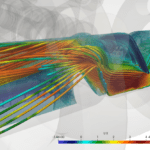
- Streamline images
- Particle paths
- Vector plots (forces, velocities, etc.)
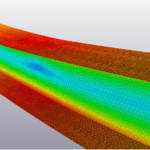
- Contour plots for scalar quantities (pressure, density, temperature, concentration, etc.)
- Time-dependent animations
How Kojouharov & Ceglarski Can Help
At Kojouharov & Ceglarski, we specialize in delivering precise and reliable CFD simulations tailored to your specific needs. Our extensive experience and expertise in CFD ensure that you receive the most accurate and actionable insights. By partnering with us, you can:
- Optimize your design process by testing virtual modifications before implementation.
- Identify potential issues early, reducing the risk of costly errors and redesigns.
- Enhance the performance and efficiency of your systems with data-driven analysis.
- Save time and resources with our expert support and state-of-the-art simulation tools.
Contact Kojouharov & Ceglarski today to leverage the power of CFD simulations for your projects. We are your trusted partner for accurate and cost-effective flow analysis.